My dear Oscar,
At the risk of repeating myself (and Lord knows, Oscar, some of the things you said have been repeated through the generations ad nauseam), I would like to enlighten you further about the linguistic and categorical changes that have occurred in attempting to define the differences that supposedly exist between individual sexed human subjects.
Now there’s a mouthful, but it is a challenge to offer you any informed social interchange without an attempt at definition. Goodness knows I will fail, but at least let me put in place some pointers.
Everyday life in this twenty-first century era presents levels of differentiation each of which compete for recognition. There are, as I have already informed you, the metrosexuals. I have, by the way, met only a few of them, charming, usually young, men who style their hair, pomade their bodies, dress in the latest fashions, use the ‘hippest’ and ‘coolest’ forms of linguistic construction and verbal intonation, and who waver between a slightly feminised but rigidly adhered to heterosexuality, and a ‘curiousity’ about homosexual expressiveness. I have seen them in every urban setting, town and city, but like all tribes they stick to their own, by and large, and only let the older gent in if he is literally a father, or a boss, or some revered cultural persona with whom it is trendy to be seen. You would have done very well with them, and would probably know them as ‘dandies’, or even as ‘aesthetes’, as you and so many of your friends were known in your own time. They are the culturally accepted sub-division of gender performance that is currently allowed to feel that they have social influence; in truth they are just the latest peacock version of the dominant class – usually straight, usually white, usually men.
The lesbians and the gays, the bisexuals, transgendered, transvestite, and queer individuals, the intersexed and the asexual beings who are now known in many circles by the acronym LGBTQIA (where there does seem to be a ‘T’ missing) are also very much in evidence, and, I am glad to say, becoming more and more vocal in their demands for recognition – and that on something of a global scale! In many settings, and in many individual cases, gone is the need to hide away and never make manifest the preferences of the homosexual subject. Now there is the chance to self-proclaim, whatever the consequences (and I cannot stress enough that at times and within certain constituencies those consequences can be dire). I must say that all of these groupings that have come into my sphere of being have been absolutely wonderful – generous, spirited, positive and above all, relatable! I count myself amongst their number! I am ‘one of them’ (which of course at one time was a pejorative term, but now is a banner of liberation and freedom fighting).
You would place yourself amongst their number too, dear Oscar, and in all honesty I find it astounding that everyone does not so align – after all who actually is 100% anything? My own favourite point of definition is ‘queer’, which is a vague and blanket term which can incorporate a myriad possibilities across all genders and all sexes, and defy any attempts at confinement or restriction. Most of the young people one sees can adequately fit the bill, at least in what is termed ‘Western democracy’. Although, truth be told, one can go anywhere in the world, enter any social setting, and one will find that youngsters push at the boundaries of sexed and gendered definition, play with the rules of personal performance, adopt different lifestyles and readily strike a pose!
Unfortunately in my advanced stage of life very few of them want to give me the time of day. There is, alas, a much understated point of prejudice: ageism! It has crept in through the course of the twentieth century, probably as a result of the emergence of youth markets, and the consequent privileging of youth oriented cultural norms. It is something else that you would not recognise, Oscar; the aged now are rarely to be engaged with, but are herded together in a sort of twilight existence of near mania and dementia and largely left to rot. They live in communities of nostalgia and rigid conformity (and the queer, I fear, is barely tolerated). A few of the young are paid a pittance to administer drugs to them and to serve them their slop, but other than that inter-generational contact is limited to the family, and then only piecemeal. For the likes of you and me, Oscar, it is very difficult to get them to notice. In that sense I suppose little has changed, except that I imagine a certain readiness to learn from the older folks of your time, a sort of reverence for age which may be my own fantasy and have nothing to do with your lived experience. I expect in many ways you just felt taken advantage of, and I am sure the renters, on the whole, were wily sorts, laughing at you behind your back. A shame – all that we have to endure in the search for a little … love? Appreciation? Notice even?
Nowadays the young, if not in person, certainly in discussion, all ‘play with gender’. Girls look like boys and boys look like girls, their fashions, hairstyles, cultural pursuits, all entirely interchangeable. It’s been going on for years! Generations even! There are those who do not seem to notice that grandparents are the ones who started all of this – flower power, rock and roll, experimentation with substances and states of mind, to produce an array of possibilities of being. I know you will have seen something of this – the hallucinogens, and the smoking of imported vapours, the alcohol of course, that great staple through the ages, keeping the peasantry drunk!
You, and your wife (which always seems absurd to say, because a gay man today does not usually take a wife, unless he wants a visa or a passport, even though many a married man, just like you, dear Oscar, is secretly gay) experimented with styles and fashions that have gone on to redefine sexed definition, and I am sure that there were denizens where men paraded in female attire, and women similarly in male dress. Why it has been reported that your male brothel keeper, a certain Mr. Alfred Taylor, was very fond of ruffles and bows, lace and ribbons and crinolines, so I assume you were no stranger to such displays. But I do get the impression that in your own time you could tell who was who, where they stood in the social order, and certainly their gender, even if it were an assumed one. There was cross-dressing, dear, we’ve always known there were cross-dressers through time, and probably everywhere. But I get the impression that in your day there were a set of clear signifiers at play – short hair and long hair, trousers and dresses, mustachios and rose blushed complexions – or so we are led to believe! Now we have an apparent interchangeability, and on occasions one really has to look twice, just to check, and on some marvellous and mind-boggling occasions one is none the wiser! I do so enjoy it when I carry on walking and do not know who has crossed my path, girl or boy! There’s a lot of fuss about it, but you know me, Oscar, each to their own!
Now I know you had your own fair share of boys in makeup, powder and rouge, boys with vaseline at their lips, and a good array of muscle bound young women, strong and swarthy from their labour, but I get the impression, with a good degree of hindsight, that distinctions were made clear, that definitions were in place. Maybe I am wrong. Maybe you would disagree with me, and argue that as much interchangeability occurred in your own era, but in any case there really was not so much fuss being documented about it. There was very little visibility. Now we have subjects who define their own sense of self in the face of social definition, who take sides, who oppose each other in their multifarious expression, and who parade their difference. It is a very public spectacle, with no attempt to hide, and visible everywhere. It is out on the streets and not behind closed doors, which in one sense is a good thing because people have confidence, are sure of themselves, can express their sense of being, but on the other hand collapses entirely our long-held and culturally shared notions of certainty itself. Which I must say I support wholeheartedly. It feels like a long overdue shaking of the foundations! I suppose any such moves were quietly brushed under the carpet when you were around. To my mind everything is so much better, with a more apparent distribution of possibilities, within reach for us all – even if it has led to a certain level of tribalism, even dubious allegiance, and a backlash – such a public backlash.
Although, and I can see a steely gaze overcoming you, Oscar dear, the current of hetero-normativity continues to hold its sway. When pressed many young people are, on the whole, ‘straight’; that is, except for the few of them who are open about being ‘gay’. Most are ‘men’, or are ‘women’, most hold on to the nomination ‘white’, or ‘black’, even ‘rich’, or ‘poor’. Precious few (and I do mean the most precious of the few, the gemstones in the rock face) embrace their multifarious components. There are recent and popular statements like: “it is our sameness that outweighs our difference”, or: “we are all more alike than we are different”, but still, when pressed, and in official censa, difference defines.
Let me explain it to you, Oscar: the strict dichotomy remains in place, an absolute adherence to the binary divide, which argues that there is male, there is female; there is heterosexual and there is homosexual; some are gay, some are straight (just as they are black or white, or rich or poor). Very many cling to the idea of being heterosexual, and not homosexual, although I am coming across a few who self-declare as bisexual, who flirt and experiment, and in their youth are willing to try anything. The allegiance to absolute points of definition has created a universe of unjust proscription, where most people find it almost impossible to reside all of the time. Most people are all too aware that they have traits that could be deemed both male and female, that their heterosexuality is mirrored by even the most tacit acceptance of homosexuality, that even locked within opposing states adherence to the same is itself defined by the other – there cannot be one without the other.
It is true to say that there is an undercurrent of indecision, that when pressed there are those who will admit that there was once a time, that I did dip my toe, that it entered my consciousness. I went with the flow, they will say, but under duress it is, in most cases, the norm that repeatedly wins out. Just as you would expect, Oscar. You know all the stories! At boarding school I fell in love with my best friend for a whole term but I am happily married now! I may be in love with a man but I can still father a child! I will establish myself in the straight world, enjoy all its opportunities, and then, if the fancy takes me, I will declare myself gay! You just would not credit the subterfuge, Oscar – or maybe you would, maybe you were living it too! How is Constance, and the boys?
Those who come to declare themselves gay, or even mixed, are outnumbered ten or twenty to one. That there is anyone who so identifies is something of a miracle, but still they are kept in the minority! It is a happy miracle that there are any at all, I would say, but it still does not go far enough. There is at least an acknowledgement of being, and a broader, forced acknowledgement that all of the old categorisations are fractured, are teetering, are on the brink of collapse! That such possibilities exist has been long fought for, and has had to overcome, in part, the legacy created by you. But still there is a distance to go. I cannot help feeling that it is the firmly held centre ground that has to be rocked, rather than the peripheries. That definition itself is the problem, endlessly trying to define, to categorise, to lock in a box and throw away the key. If I am gay does that mean that I am not straight? If I am straight does that mean that I am not gay? If I am man does that mean that I am not woman? If I am woman does that mean that I am not man? White? Black? Rich? Poor?
My own richness of mixture may not be so apparent to you, but it makes me such a tasty, zesty, sugar and spice fruitcake that you should welcome me to any tea party.
Oh, Oscar, come back and make us laugh about it all! If only you could take away the seriousness of it all with a frivolous barb!
If only that were possible – dear, dead, and shovelled into history Mr. Wilde!
I remain,
Your friend, and mine,
Algernon B. Duffoure.
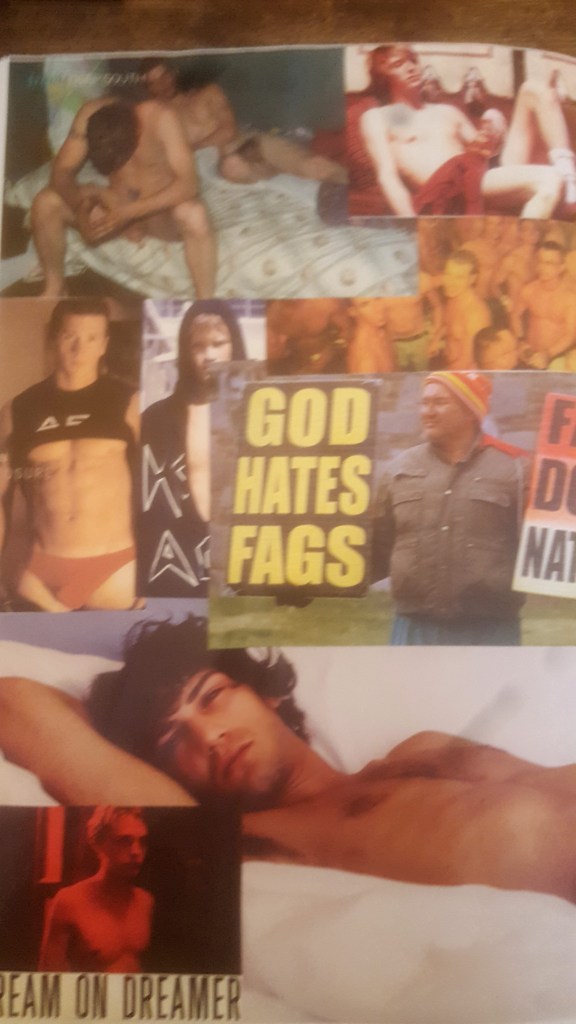
 Letters to Oscar Wilde