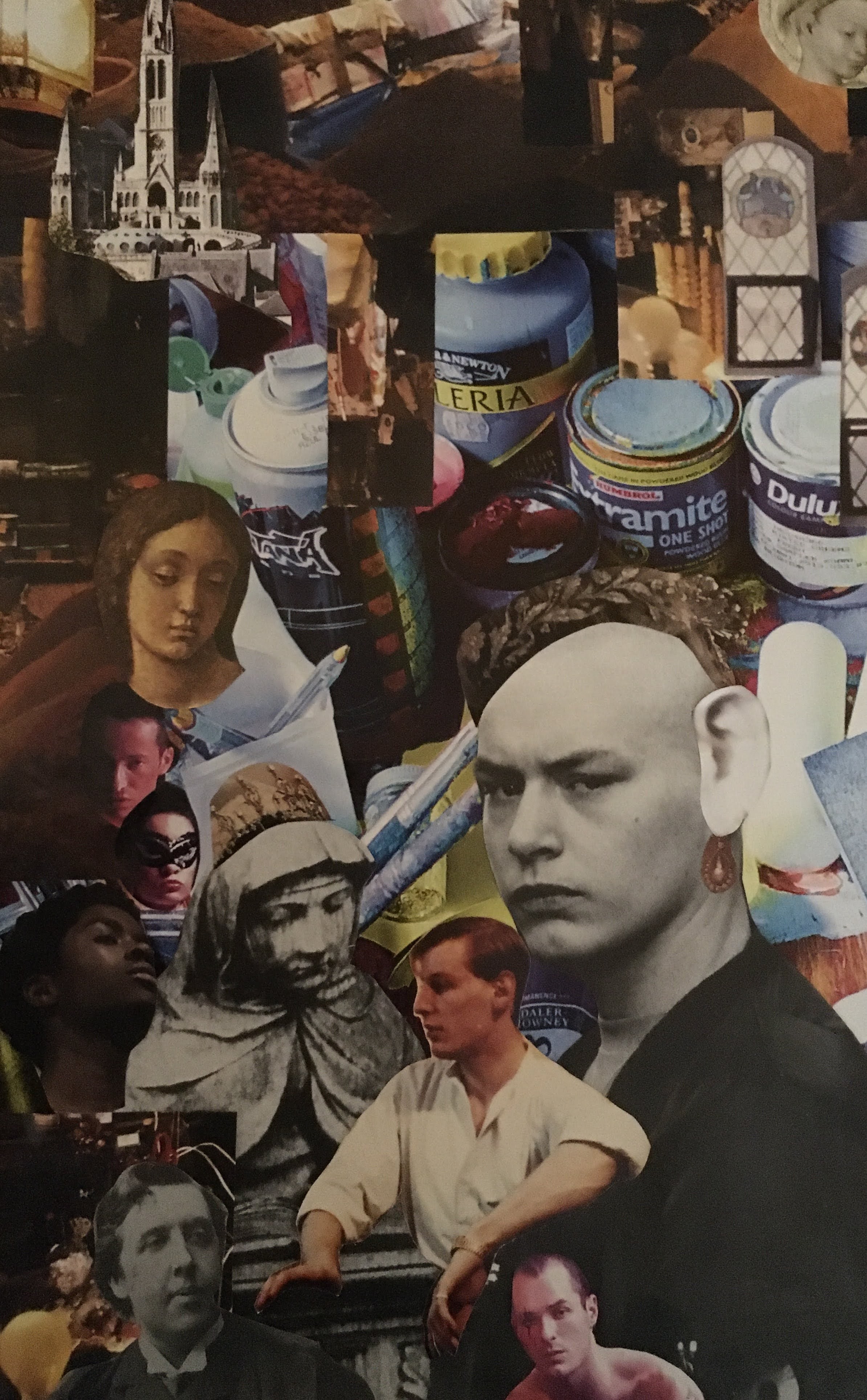
Miracles

Dear Oscar,

I was noticing how easy it is to breathe. I was thinking about it because in the midst of the pandemic which is currently gripping and affecting the entire planet, it is still easy to breathe. Easy to breathe even though we are constantly being told that air quality is deteriorating and that the lungs of the earth, the rain forests of the Amazon, are being decimated. My breath still flows, in and out, regulated, barely noticeable, expected, in spite of dire warnings that traffic pollution is choking our major cities, and that we as a race are susceptible to the blocking of our airways through allergic reaction, through infection and the dreaded virus of the pandemic itself. There is an ongoing and ever increasing narrative which seems to threaten even this most basic of requirements – the fear that we have created a planet where it will no longer be possible to breathe, and that that will be our collective demise. I wonder why it is that we have to subject ourselves to such a level of fear?

Of course I am also quick to acknowledge that if any one of us does suffer any form of breathing difficulties then of course measures need to be taken to protect us. It is self evident that the most basic of life forming activities have to be safeguarded above all else, and that should any of the threats that are so meticulously detailed come to have actual impact, then we as a collective, as a human race, need to eradicate them. But still I am left wondering why it is that these threats, generating abject fear in very many subjects, have to be the grand narrative trope of our age. We are poisoning and choking ourselves, or so the story goes, and no matter what efforts we put in place to try to counter this, the creeping certitude of annihilation is everywhere apparent. This is the undercurrent of out age, the subtext, as if we as a race will bring it upon ourselves because we know no better, because we are sinners, because we give in to greed and lust and all seven of the seven deadly sins. Because we are stupid children who require nothing but self satisfaction, a kind of self-pleasuring and self indulgence, no matter what the consequences for those around us or for the world itself. Oscar, dear, I just do not buy it.

Yes I know that I am compromised, that I am co-opted into ways of being that I might come to question, that I take flights, and drive a car, eat some mass produced foodstuffs, drop a piece of litter once in a blue moon, but I cannot recognise myself as the arch villain out to destroy the planet. I am conscious and aware and do my best, as do most human subjects, to avoid the sorts of consequences with which I am being threatened. And if I do not understand all of those threats, because the big businesses and corporate giants, the state monopolies and intensive farming techniques, keep me ignorant, despite my enquiring mind, then all I can do is all that I do.

I know that your world was not encountering this, not to the same degree. But you were classified as a sinner by your society, to both a greater and a lesser extent, and you were branded by your world, and made to live out a life ever conscious of the sins you had supposedly committed, and I just have a suspicion that such tropes are endlessly repeated, if differently classified, just to keep us all controlled. You can do this, you cannot do that … we are feeling it all keenly at the moment.

Best wishes to you, as ever,

Your friend,

Algernon B. Duffoure.

Position of Privilege

Dear Oscar,

Even holding an opinion and being allowed to express it is a position of privilege. You and I are very lucky to be in positions where we are able to express ourselves, have the ability to write and play with words, can put forward our views from our positions that are entirely privileged. Most of the time we have been little aware of the fact that we are in such positions, just take it for granted and assume that our worldview is the worldview, and that of course everyone is entitled to think whatever they like, to say, and even to no small degree, to do, whatever they like. In being caught up short I suppose you were taught the lesson that you cannot do quite all that you might wish to do, and that with the position of privilege comes also no small measure of responsibility; that particular ‘smacked wrist’ reverberates through the ages, and comes to influence the relationships which the modern entity has with his or her own position of privilege. Maybe it is true to say that the ‘flip-side’ of assumed privilege has to be responsibility, and that the indulgence of the self has to take account for the impositions that this may place upon the other.

I am aware that I take so very much for granted, that I am able to speak my truths and assume that they will be everywhere understood, and agreed with, and that of course is not actually the case at all. It is true to say that the populations of the globe are moving towards levels of uniformity, and that the mass dissemination of information is to no small degree starting to regulate thought processes and even actions, because essentially we are all being told the same things. There are still divisions of ideology, and there are levels of interpretation that might well differ from subsection to subsection, but essentially of course the same needs have to be met across the globe, the most basic needs of sustaining life, far above any imposed, or learned, system of belief, and even in spite of adherence to one hegemonic correlation over another. We may all be being co-opted into increasingly dominant orders of being, but these cannot be at the expense of survival itself.

Or so, from my privileged position, where I believe that what I say must be true, I believe. I have never experienced a state where life itself is subordinated to the needs of a dominant order, but when I scan the imagined and the recorded archives of human experience then I see that I am actually very fortunate, and that such states have certainly existed. Would my life have had any meaning if I had been a worker helping to construct a pyramid in ancient Egypt? Would my ability to think, to question, even to express, have made any impact at all upon a system which saw me as expendable? And that from history; I am sure that through history and into the modern age there would be examples, perhaps more subtle, perhaps less easily classifiable, that would prove the same point.

Be content, Oscar dear. You dallied before your arrest, and you dallied again after it, and have come to represent a triumph for what you advocated within your dalliances. Be content, Oscar; those who came after you, and those of today will fight the battles for you, from all of their positions, of privilege.

With best wishes to you,

Your friend,

Algernon B. Duffoure.
What we have

Dear Oscar,

I know that your incarceration will have been a very low point in your life, but it has crossed my mind that actually it served you well in unexpected ways. You did after all write the epic letter to Bosie, ‘De Profundis’, a great work which reverberates its truths through history, and you were inspired to compose the poem ‘The Ballad of Reading Gaol’, which similarly now holds an enviable position within the canon of world literature.

What is more, in the depths of such deprivation, you were thrown back on to yourself alone, with none of the stimuli of the world in which you had so eagerly moved, none of the distractions, the pretences, the dreamy romanticism. It is no doubt true to say that I have no idea of what it must have been like, and never can have, because such regimes are lost to us, altered through time, different in the ways they take their effect and have their impact. The world in so many ways is seemingly so different. Yet I cannot help thinking such a level of loss, of enforced denial, that the inability to sate the excessive appetites of success and celebrity, may in turn lead to some appreciation of what we all truly have, which is very little, which is only ourselves. I know that public censure must have been extremely hard to bear, but to recognise the nobility of the self even in the face of castigation, to see that the two lungs will breathe, the heart will beat, the senses remain, must have offered some little solace. It is all just making me appreciative of the fact that I have all of these things and also my liberty (such as it is in our modern era).

I am increasingly aware that my possession of health and well-being are the most powerful tools that I have in navigating my way through a life which is not uncomplicated, not un-beset by daily issues, by problems great and small that arise from time to time, by expectations and disappointments, by dashed hopes and broken promises. Thinking of you, Oscar dear, leads me to acknowledge that the most basic of advantages that all of us possess, just the breath that flows, the blood that pumps, is enough; everything else is ‘icing on the cake’.

I have a part to play in maintaining my health, my mental stability, my feelings of ease, my joie de vivre. I feel in some sense that I have a duty to myself, that I must expect of myself not an unwavering recognition of my needs, but always the ability to pick myself up should I fall, to set myself back on a familiar path should I digress, to keep on taking steps forward. I, like the majority of the earth’s inhabitants, the overwhelming majority, perhaps even, in some sense, everyone, can transcend, remind, imagine, reach. I am presented with choices at every juncture, and I have the ability to make choices that are of help to me and my world. It is, in so many ways, a glorious thing to be thrown back upon one’s own resources, to have to manufacture for oneself the road map leading back to some sense of salvation, of preservation.

I am happy.

I can continue to be happy.

Your friend,

Algernon B. Duffoure.
An alternative

Dear Oscar,

I hope this letter finds you well. I hope that your presence across the span of history is somehow at ease, and that you can view from your vantage point with compassion. After all, your own faults were more known to yourself than they were to anyone else, and that is true of all of us.

I have been writing to you recently about how slowly time advances, and how changes in opinions and social mores are even slower, but that if we wait long enough, and look back through aeons, there are indications that some elements of human evolution are to the benefit of man, and beast, and planet itself. Admittedly they seem few and far between, particularly as the worst possible elements of human interaction keep on reasserting themselves, even in the face of the best. I suppose one has to assume that it was ever thus – but I wonder if that need be the case?

Evolution seems to imply a state of being that is not one of stasis, that there is movement, that there is change, that alternatives come into being. I have been giving this much thought, as set in my ways as so many of us are; as you were, Oscar, even to the point of your own demise. Is the failed hero a real hero?

It seems to me that change comes also very, very slowly, and that in reality change comes in the smallest of moments, the tiniest of gestures, in those quick and fleeting seconds where one actually does do something that one did not do before. I think that it is in its insignificance that its actual significance lies. Taking an alternative route, a different course of action, and actually making a decision that is unlike decisions that have been made before, that would seem to me to indicate real change. It is as simple as choosing not to butter one’s toast in order to reduce one’s fat intake, and then repeating the action, day after day, until a ‘new normal’ comes into being. Not to put the cigarette to one’s lips; not to fill the glass of wine brimful; not to ignore the neighbour as they appear in their garden, but to say: “Hello”, and then to say: “Hello” again; not to put one’s cross into a familiar box on the ballot paper, just to move one’s hand, just before it happens, whatever the consequences may be imagined to be. Taking the alternative, with precision, or sometimes recklessly, and re-charting the course.

If you, dear Oscar, had not …. but then of course, you did.

Your friend,

Algernon B. Duffoure.

In the now …

Dear Oscar,

I wonder what happened to you when you received the missive from Queensberry, Lord Alfred’s father, calling you a ‘sondomite’ (sic). I suspect that you flew into an over-emotional rage, or maybe you rolled your eyes in a world-weary way, or guffawed at his poor understanding of the English language, or felt superior, probably that above all, felt superior to his brutish ways with your over-developed sense of aesthetic propriety. It must also have been very strange, in that moment, to be confronted with some level of truth, if truth it were, that you were a ‘sondomite’ (sic). It must have been disconcerting in the back of your mind, thinking over the many conquests that you had enjoyed, the interplay with the ‘street-arabs’, the establishments through which you had prowled in your search for the ‘panthers’. Even if in actuality you had never practised the art to which ‘sondomite’ (sic) refers, I am sure there was the ring of truth to the accusation – remember the ‘soiled sheets’ that were referenced by the chamber-maid at your trial, or did she lie? Was she paid to lie? That ring of truth must have smacked you hard, caught you sharp, made the very instant when you read the word – ‘sondomite’ (sic) – one that chimed sonorously something of a death knell in your mind, a reverberation that has never left you through history.

I am concentrating upon it, Oscar dear, not because I wish to torture you in any way, not because I wish to bring up the most painful of memories for you (and I am sure this was not the most painful), but because I am interested in what we all do when moments occur that rattle our being, shake us to the core, make us stop and stand still, and start to think things through. My suspicion, as I say, is that you reacted in an over-dramatic way to the accusation, whether or not that was made manifest in your behaviour or outlook; I suspect that inwardly you ‘flipped’. This of course jeopardised the next few moments, and then put into question your reactions as they ensued, as it must for all of us, when we are shocked, when we are caught up short. Those ripples of after-effect come to condition to no small degree all that happens next, but only moment by moment, each second unfolding, becoming something in itself, building up the slow minutes, and then the passage of time, and then those little ripples swell to be a tsunami. It puts into our own hands a huge amount of power, as orchestrators, as directors, as the ones who are in change of fate as it unfolds, the future as it is made known, destiny. There is probably a time for the over-dramatic, for the flying off the handle and taking sudden control, but is it a time linked to high emotion, linked so inextricably to fear, making of each act, each singular response, something of a portent? My dawning understanding is that in those moments our actions may well be ill-judged, and not fully formed, and not take into account all of the many influences and variables that might come to take effect. For you, Oscar dear, with your wounded pride, and your public reputation to defend, and the investments of those who were close to you, those who were benefiting from your wealth and your celebrity, it was the precursor of a now infamous doom. Or so the narrative goes. That is the story that is told. It may be true, it may only be an interpretation. It may be myth. What we know however is that you were carted off to a prison cell, that you did undergo what was known as ‘hard labour’, and that your career was left in tatters. Rightly or wrongly, justly or unjustly, that bears the ring of truth.

My own interpretation is that you did not remain steady, and that your ego came to the fore, and that you played a greater part in your downfall than might at first be acknowledged, that in effect you were not only a victim of the age, but an architect of it. Now I know that you were given few choices, that as the net tightened around you there were fewer and fewer outcomes possible that might have brought to you a different fate, but I cannot help thinking that choices are always present, no matter the circumstance, and that therefore different conclusions can be reached. You may not have come to be a symbol of your age, nor a touchstone for liberatory potential, but you could have been a happier man. It is a question, is it not: to put yourself on the cross to be crucified, or to live on?

I am presented with my moments, moment by moment, the now, and now, and now. The lessons to be learned from your example reach deeply, and take me into contemplation, and make my choices ever manifest …

Your friend,

Algernon B. Duffoure.

Levels of Irritation

Dear Oscar,

The wind is blowing today. I expect you listened to the wind from inside your cell, as well as witnessing it in all its fury within society. I find it is beginning to irritate me.

It is irritating me not because there is anything particularly unusual about it, not because it is a more terrifying wind than there has ever been, and not because it is destructive, or incessant, or creeping in between the gaps of the buildings I inhabit; it is irritating because I am allowing it to be.

I think of nagging children who pester and cajole, but who of course give up entirely if one does not accede to them; of pet dogs who want to be stroked, to be played with, to be the centre of attention, but who slope off to sleep if one does not participate, waiting at the sidelines until one is ready for them. I think also of my amounts of money, that flow in and out of my life, of the anxiety that accompanies them. When there is much, I worry about the amount disappearing, and when there is little, I worry that I will not have enough; all absurd, pointless and absurd.

Like you Oscar, as is evidenced in the works that you left behind, there are very many things that irritate me, and I have to acknowledge that I am very easily irritated. The banalities of a class system which oppresses not only those who are oppressed but also the oppressors, who have to conform to set standards, who live in shabby gilded cages, working within the narrow confines of their pretended respectability. The denial of natural love, of all the many loves that have dared not speak their names, the ways of being between peoples that are gentle, and friendly, and giving, the loves that radiate in small scope from those at the touchline watching the absurdities of action. All of the mothers, all of the siblings, all of the quietly watchful, holding hands and caressing, putting their loved ones to bed with kisses across the eyelids; the many loves that are not sensationalised, and which continue, beneath the surface, barely acknowledged. Even those that involve desire, regulated, careful and caring, a man with his arms around the shoulders of his closer than close buddy, and a young woman kissing her girlfriend goodbye.

It just seems to me, Oscar dear, that irritations are largely invented, and allowed to fester, and if they are truly real they can be addressed. But if they are the buzzing of the bees, the singing of the birds, the crashing of the waves, the howling of the winds, the touches of a friend, the embraces of a lover – then they do not need to be any more than you and I, and we and they, allow them to be.

Your friend, as ever,

Algernon B. Duffoure.

Inviting Pressure

Dear Oscar,

Of course I know that what you chose to do – to stay and face the music, to own up to your approach to life and aim to justify the ways in which you chose to live – became a cause célèbre that has come to influence the ways in which more modern societies have developed. I know that by being steadfast you did uncover a side of your world’s mores that could be objected to, that probably needed reform – that in being addressed has put right some wrongs and opened up alternative ways of being. Nevertheless, I am being slowly persuaded that so much of what ‘hits the headlines’ and becomes the touchstone of an age is in actuality a lot of fuss about nothing. It just seems to take history for that to be the case, and the generation and popularisation of sets of ideals that go against whatever it was that caused the ultimate umbrage at the time.

You see Oscar, you did, in hindsight, sort of invite disaster, and a huge amount of pressure to be heaped upon you – so much, it might be argued, that it was impossible to behave in any way that might be deemed rational. You steadfastly held your position, and although that may be seen as laudable, the price you paid was so high as to deny you existence at all! Did that have to be the case? And did it have to be the case that your legacy of martyrdom still sticks like a mal odeur even around the modern depictions of the homosexual? I think of the century of suffering that has been enacted since your too early departure from the planet, the inevitable fight for freedom of expression, the fiery street protests, and the battles that were fought with words, and with rocks, and bricks, and cricket bats. It may have all been inevitable, but I do just wonder. I do just wonder if not inviting disaster might also have been an option; that you could have exited to Europe and used your mightiest of weapons, your pen, to argue for a more just society where there would not be persecution – which also had a ring of inevitability about it, as all societies were advancing in the greater sense, and still are around the globe, and ‘old’ ideas become replaced with ‘new’ ones, and democratisation, such as it is, for now, seems to hold some sway. Do you really believe that without your humiliation and suffering there would have bee no gay liberation? Somehow I think it would have been different. I worry that the taint of your treatment lingers even in the face of the most advanced developments. I worry that I need to worry, and that is both the point of this letter, and what I most ardently wish to subvert and deny.

All may not be so well with the world, and all of us carry some worldview where we know of instances where there are injustices and misdemeanours, but it is also true that all is also well with the world, because flowers do continue to grow and bloom – even green carnations! I know as well as you did that I can provoke disaster, that I can invite pressure into my life, that I can cause a stir, worry myself silly, pick and probe and prod and upset everyone who surrounds me, but I do wonder to what end? To get my own way? To be right about whatever it is that I wish to undertake? To try to mould the world in its entirety to my point of view? It all seems rather foolhardy, Oscar dear, when it is obvious that humanity loves humanity, and always will. The differences and the factions and the fights and the oppositions are so few and far between compared to the commonalities of being: the air that we all need to breathe; the water that we all need to drink; the sustenance that we can engender for ourselves, in all its forms, for our mutual well-being.

I am doing my utmost not to invite pressure into my life, Oscar, without compromise and with a sense of being true to myself and my world. I wonder what your life would have been if you had been able to do the same.

Your friend,

Algernon B. Duffoure.

The Bigger Picture

Dear Oscar,

You undoubtedly could not see beyond your own sense of entitlement, your own pursuit of pleasure, and that is why you were unable to see how your lifestyle would impact upon the world around you. It is rather surprising, given that you were actually very astute at reading the mores of your day, as reflected in your writings; you could see very clearly that the world you inhabited was full of contradiction, was a place of secrets kept and secrets held and secrets sometimes made public in order to bring down others. I am sure that to some no small degree you actually participated in such activities, and that your ribald wit was ever ready to lampoon those whom you held in disrespect, or whom you saw as threatening your position of preeminence. I wonder if you have any regrets, Oscar, and suspect that your response would be that you have none. A strange blind spot, not seeing how things would unfold, when it was very obvious that the world was turning against you – and even you must have recognised that! I suppose this is why history has accorded to you the moniker of ‘victim’, of ‘martyr’, no less, as if the nomination of cultural sainthood somehow atones for the sins of your age – not your sins, but the sins of your age.

It is, as I have said before, much the same now. Now it is possible to get completely lost in the trivialities of the everyday, the pursuit of recognition, the need to make oneself important, the pursuit of endless diversion and the promise of unending pleasure, to satisfy the most basic of lusts and wants and perceived needs, and to miss entirely what is actually going on. In fact it is quite evident that such tactics can be used to hoodwink entire populations into regimes of control, where diktats are the order of the day, where the room for freedom of thought and freedom of expression are slowly eroded – because – we believe we can say what we want, but in actuality we are only saying what we are allowed to say! We live in an age of endless choice, but I have often thought to myself is there really any choice? Just because we can have a red car or a blue car does that mean that we can operate without a car at all? Is there really a choice, or are we all just slaves to whatever system is the order of the day? And if we are presented with real choices are we able to see them clearly, without our own stubbornness, our willfulness, standing in the way; or, more pointedly as is today’s experience, without the endless proliferation of ‘choices’, of ‘alternatives’, diverting us subtly, or not so subtly, away from any notion that real choice actually exists at all?

One would think, Oscar dear, with examples like your own to look back upon, that there would have been some sort of advance in thinking, but alas there is not. Oh, and I know that there is an argument that without your own ‘noble sacrifice’ there would have been no recognition of the plight of the homosexual, that the start of ‘gay liberation’ would not have occurred, and that there would still be persecution of sexual minorities, but really, is that valid? Is it the case that there have to be real levels of suffering before the world at large works out that persecution of anyone is not such a good idea? I am thinking of issues of race and religion, of caste systems, of slavery, of skin pigmentation, of difference however it may manifest itself. Does it really have to be that only after decades, centuries, lifetimes, millennia – that we as a human collective will realise that beating up on the other simply perpetuates the very suffering that in another breath we are all so adamantly against?

I leave you with that little poser, Oscar – from one poseur to another!

Best wishes,

Algernon B. Duffoure.

Change

Dear Oscar,

I have been thinking a lot about change.

I get the impression that despite the absolute censure of the society around you, your imprisonment, your public castigation, your personal degradation, you did not change so very much. I think you believed that you were right in what you thought, and that your actions, however they may have been interpreted, were just. I am sure that you thought that the world around you was wrong, and that you were right.

We all do. We all hold on to fundamental beliefs that we have been conditioned to accept, or that our personal circumstances have drawn us towards, or that our society dictates. The vast majority of us tend to accede to the dominant sets of opinions, to go with the flow, not to question in any fundamental way what we have been taught and what we have learned, in the very broadest of senses. It has made me think that we hold on to belief systems that are the dominant order, even when they are doing us no good, even when they are set against our growth, our potential, our reaching of our zenith. So, if we were citizens of Ancient Rome, we would believe that slavery was acceptable, needed, simply the norm; we would ‘go to the games’ and expect to see bloodshed, to witness death, a pantomime of murder played out before us. If we were eunuchs at the court of Imperial China we would accept that our manhood was removed, that our opportunities to procreate would disappear altogether, that our lives would be about administrative service. If we did not accept these things then we would be cast out from these societies. In the England of the nineteenth century you, dear Oscar, had to accept that your behaviour with the ‘rentboys’ was seen as scandalous, was unacceptable to the world in which you moved so easily, was the ruination of your reputation, your career, your liberty. Whether these things are ‘right’ or ‘wrong’ is only the decision of the age; if they are deemed ‘wrong’ then there is a price to pay.

This has made me reflect upon change that is personal, the decision to alter one’s diet, to give up a bad habit, to shift one’s perspective. It seems to me that this is so very difficult because there is a deep-rooted fear that change itself will bring uncertainty, and uncertainty throws into chaos the long-held beliefs that make up a being. If I believe that being a ‘good’ person means that I will be rewarded, or can reward myself, with sugary treats, then I am actually doing myself a disservice as I ‘pile on the pounds’, compromise myself with the possibility of diabetes, put my heart under strain; when that is the dominant belief then rewarding oneself with an apple or an orange seems to go against the grain, take away the very belief that I may see myself as ‘good’. To give up smoking cigarettes when one sees oneself as the contemplative coffee shop visitor, veiled and wreathed with foul scented smoke, thinking through, with crossed brow, one’s place in the world; when one is the professional cook, ladling on cream, slapping around pounds of butter, producing celebratory cakes (because there is no celebration without a cake). It makes my head hurt, Oscar, even to start to think about it all.

You see, Oscar, I see very clearly my faults, as I am sure you did too; it is whether I actually want to do anything about them, to change the essence of my being, that becomes the central question.

I will let you know,

Your friend,

Algernon B. Duffoure.

A Glorious Day

Dear Oscar,

I hope this letter finds you well; I hope that in the midst of your prison of misunderstanding you get some pleasure from the letters that I send to you. Thank you for taking the time to read them; I appreciate my voice being heard.

I was out walking, just taking some air, with no real purpose and no direction, just ambling along, looking around me, taking it all in. It struck me how much there is to take in. It struck me that I live within absolute abundance, and that everywhere there is the teeming and the multiplicity of humanity, with its impact on every horizon. That in itself made me appreciate all that humanity is able to do, without judgement, seeing the homes and the thoroughfares, the protections from the elements, shelters simple and elaborate, walkways and byways and mountain paths.

Of course we tread upon nature, the natural world, the world that grows and flourishes around us despite our every intervention. It struck me that though we tread on nature, nature very quickly treads back, filling our paths with its plants, finding all the nooks and the crevices where it can seed, multiplying endlessly. I noticed that no matter how I was feeling small trees would continue to bud and shed their almond shaped leaves, pale and yellowing in Autumn, green and piquant in Spring, and that blossoms would open, infusing the air with scent both strong and subtle. There would be wind and energy, flight and function all around me, whether I took the time to see it and to sense it or not. There would be so much of it going on that I would not be able to encompass fully its impact, not through sight, or touch, or smell – there would always be an endlessness from times I knew nothing about and into times I will not experience. A cold day, a warm day, just the vibrancy of it all whipping around me, caught in still tranquillity, lost in a windy squall.

I am, like you Oscar, beset by all the problems of the world, that weigh themselves upon my shoulders, that keep my head bowed and my vision small; just looking, without effort, just letting the world in, put all that away.

Your friend,

Algernon B. Duffoure.